Phasics
- Wavefront, MTF and QPI measurement solutions
- Products
- Applications
- Markets
- Company
- Contact us

Aug. 5, 2026
Optical vortex beams are distinguished by their helical phase structure and, in many cases, their characteristic donut-shaped intensity profile. They have become indispensable tools in modern photonics. Their unique phase structure enables a wide range of applications, including optical tweezers, quantum communications, advanced microscopy, laser beam shaping, and structured light research.
At the heart of these beams are phase singularities, locations where the optical phase is undefined and around which the phase winds in a spiral. These singularities determine the beam's topological charge, a fundamental property directly related to the orbital angular momentum (OAM) carried by the light. Accurately locating and quantifying these features is essential for verifying beam generation, assessing optical system alignment, evaluating beam quality, and supporting research involving structured light.
While wavefront sensors (e.g. SID4 HR) provide accurate phase measurements, extracting information such as phase singularity locations and topological charge has often required dedicated post-processing, custom algorithms, or manual parameter adjustments. Integrating these additional analysis steps into a routine measurement workflow has remained a challenge.
Streamlining Complex Wavefront Characterization
To simplify this process, PhaseStudio software now includes a dedicated Vortex Analysis feature that integrates phase singularity detection directly into the standard wavefront analysis workflow. Once a measurement is completed, the software automatically identifies phase singularities within the measured wavefront and reports their spatial coordinates together with the corresponding measured topological charge.
Beyond singularity detection, the feature separates the wavefront into complementary mathematical components that help distinguish rotational and non-rotational phase contributions. This enables users to isolate and analyze localized vortex structures that may otherwise remain embedded within the overall phase distribution. Rather than relying solely on visual inspection of the phase map, users gain quantitative information that supports localization, classification, and further analysis of complex optical fields.
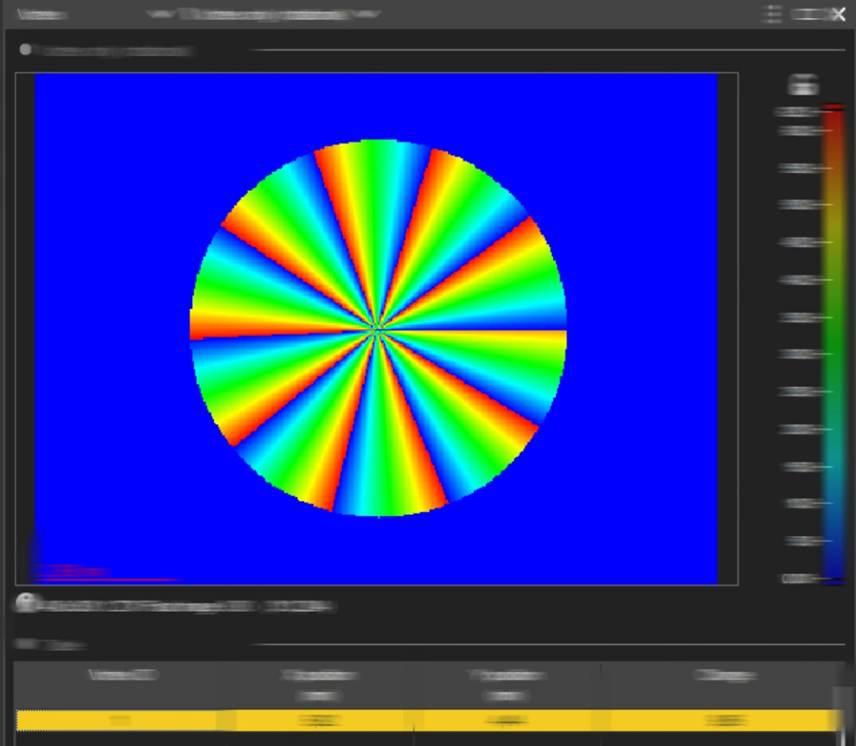
Figure 1. Example of a rotational phase distribution with a measured topological charge of approximately 9.85, corresponding closely to the expected integer value of 10. The phase varies continuously in a spiral around the singularity, producing the characteristic optical vortex structure. (Image from Phasics internal test data, PhaseStudio analysis results.)
As optical fields become increasingly sophisticated, visualizing the phase alone is often insufficient to fully characterize localized features. By automatically identifying and quantifying optical vortices, PhaseStudio provides direct insight into the topology of the measured wavefront, helping researchers and engineers analyze structured light more efficiently and with greater confidence.
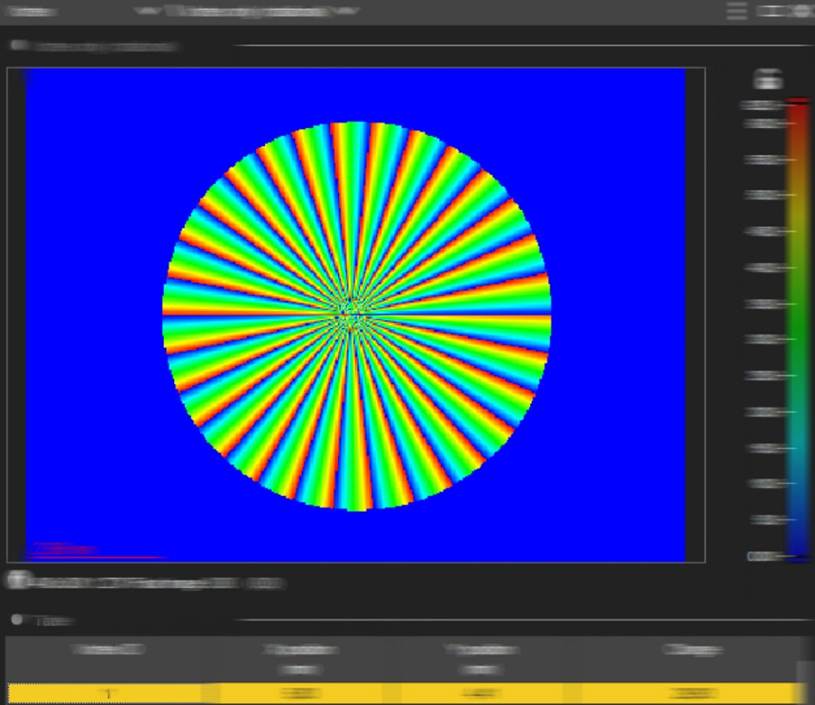
Figure 2. Rotational phase distribution with a measured topological charge of approximately 29.93, corresponding to an expected value of 30. As the topological charge increases, the helical phase structure becomes increasingly dense around the singularity. (Image from Phasics internal test data, PhaseStudio analysis results.)
Supporting the Next Generation of Structured Light Applications
As optical field engineering continues to advance, analysis software is playing an increasingly important role beyond data acquisition and visualization. Modern wavefront metrology must not only measure optical phase accurately but also provide the analytical tools needed to interpret increasingly complex optical fields.
With the introduction of Vortex Analysis, PhaseStudio extends its capabilities beyond conventional wavefront visualization by enabling automated identification and quantitative characterization of optical vortices. Whether supporting research in structured light, orbital angular momentum, advanced microscopy, or beam shaping, this new feature helps transform wavefront measurements into actionable insights.
To learn more about PhaseStudio and how its Vortex Analysis capabilities can support your beam metrology applications, contact the Phasics team at contact@phasics.com.